The next epoch of organizations
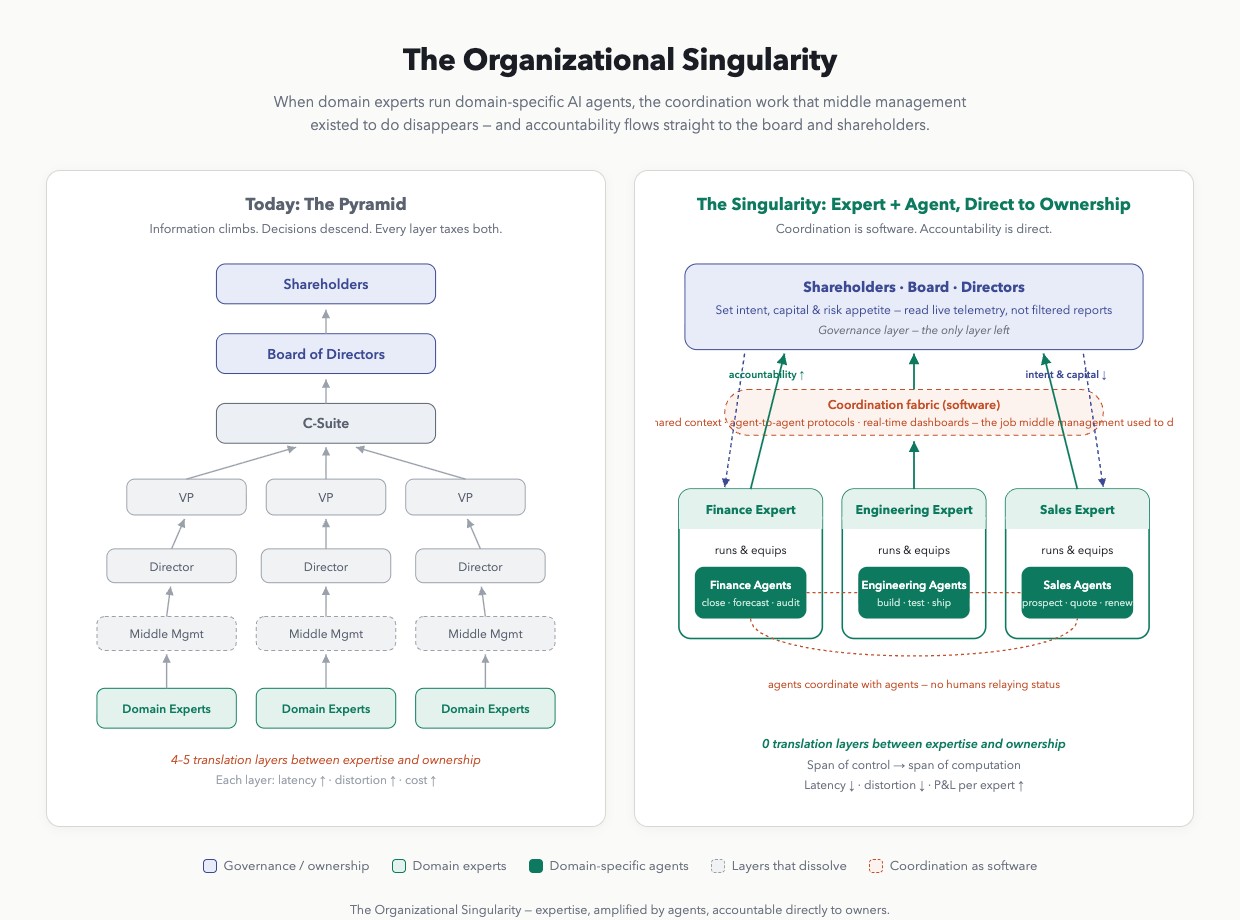
Your company is shaped like a pyramid for one reason: coordinating humans was expensive. AI agents just turned coordination into Service as a Software (next-gen SaaS) — nearly free, always on. What remains is a spear: experts at the tip, agents doing the routing. This is the Organizational Singularity.
Why the pyramid existed — and why it's over
In 1937, Ronald Coase explained why firms exist: coordinating people through markets is expensive, so we built hierarchies. Every management layer is an information relay — a human router. AI agents just made routing, status updates, hand-offs and routine decisions nearly free. The economic reason for the pyramid is dissolving in real time.
Hierarchies emerged because one person can only supervise a handful of others. Information crawled up the pyramid, decisions crawled back down. Speed was sacrificed for control.
Autonomous agents absorb coordination: routing, reporting, reconciliation, follow-ups, routine approvals. Domain experts talk directly to the executive team. The org becomes a spear — a sharp human tip on an agent shaft.
Not "humans in the loop" (that scales linearly and kills speed) — humans above the loop: setting constraints, validating outcomes, owning the judgment calls no algorithm may make. That's also what EU regulation now demands.
The same force that reorganizes your hierarchy reaches your vendor contracts: subscriptions to SaaS (Software as a Service) and licensed enterprise software are increasingly displaced by AI-agentic coding — bespoke systems written, maintained, and evolved by agents under human governance. The consequences are threefold: licence and subscription costs collapse, quality rises through continuous regeneration, and time-to-market latency shrinks toward zero — software arrives at the speed of the decision to have it.
The concept
The term — coined by Salim Ismail (founder of OpenExO, author of "Exponential Organizations" and "ExO 3.0 — The Organizational Singularity") — describes the inflection point where organizations flip from human-centered operating models to AI-native intelligence systems: companies that sense, decide and adapt at machine speed, governed by a small human core. Ismail and Peter Diamandis unpack it on the Moonshots podcast (EP #258, "AI-Proof Your Company").
The architecture (credit: Salim Ismail / OpenExO)
ExO 3.0 gives the destination a concrete shape. We use these frameworks in our engagements — openly credited, applied to your P&L.
The Massive Transformative Purpose becomes machine-readable: hard constraints agents may never violate, weighted priorities for trade-offs, and cultural identity.
Decision architecture, Recursive learning, Intelligence stack, Value moat, Elastic agency — the loops that make the company compound instead of just automate.
Safe autonomy, Human architecture, Adaptive structure, Purpose control, Ecosystem trust — governance so speed doesn't become liability.
Purpose, Sense, Interpret, Decide, Orchestrate/Act, Learn — a continuous OODA loop at machine speed, wrapped in a GOVERN/ASSURE control plane: evals, logs, rollback, human review.
Six sequenced steps from today's org chart to the AI-native operating model — Direct Mode for companies ≤50 people, Edge Mode (an "Edge Twin" cell) for everyone larger.
Purpose, judgment, capital allocation, relationships, accountability. "The algorithm decided" is never an acceptable answer — a named human stands behind every consequential decision.
Advisory
We are practitioners before we are advisors. Our agent systems operate in production every day — recruiting talent, sustaining operations, rendering account of their own work. Our counsel extends solely to what we have conceived, deployed, and proven ourselves.
Where does your organization really stand?
Prove it on real workflows before touching the core.
The guided migration to the AI-native operating model.
For boards and leadership teams that need clarity now.
FAQ
No. Digital transformation digitized existing workflows. This changes why the firm exists: Coase's coordination costs — the reason hierarchies were built — are collapsing. IDC projects the number of active AI agents to grow from 28.6 million (2025) to 2.2 billion (2030) — and the tasks they execute from 44 billion to 415 trillion a year. When coordination is free, the pyramid is no longer a rational structure.
Neither. Under ~50 people you can apply the playbook directly to the whole company (Direct Mode). Larger organizations start with an Edge Twin — a 3–5 person cell that rebuilds one coordination-heavy function AI-natively and proves the result on live workflows before anything else changes (Edge Mode).
Governance is the core of the architecture, not an afterthought: permission envelopes, trusted evals, searchable logs, granular rollback and a human review queue. EU AI Act Article 14 (in force Aug 2, 2026) requires exactly this — humans able to oversee and override high-risk systems. "Humans above the loop" is the compliant design.
The honest answer: coordination roles change most. That's why transition architecture is part of every engagement — realistic absorption modeling, 6–12-month learning curves, new exception-handling and mentoring roles, and a deliberately engineered junior loop so you don't destroy the pipeline that produces tomorrow's senior judgment.
Because we operate this ourselves. Our agent fleets run recruiting funnels, market analysis and autonomous reporting in production every day (see dersalvador.com). You get practitioners who have made the mistakes on their own systems — not a slide deck.
No — Filekeys is an independent advisory by DerSalvador. The concept "Organizational Singularity" and the ExO 3.0 frameworks are the work of Salim Ismail and the OpenExO community; we credit them openly and apply the public frameworks in our own engagements.
Contact
Tell us where coordination hurts most. We reply within one business day — with a concrete first step, not a brochure.
stieves.schmidt@filekeys.com
Filekeys GmbH · Chaltenbodenstr. 26, CH-8834 Schindellegi